the lost corner of England
Never Let Me GoThe lost corner of England is the name the students give to Norfolk as a place where lost things might turn up. What begins as a childhood joke becomes a shared language for longing: Ruth uses it to frame a search for her possible, while Tommy later carries the idea into an effort to recover Kathy H.’s lost cassette. In Kathy H.’s retrospective account, the phrase’s playful promise sits beside losses that cannot be reversed, including the disappearance of Hailsham and the deaths of her friends.
Origin as a Shared Joke
The Norfolk idea began in a lesson when the students were young and persisted for years as an in-joke. Kathy H. recalls that origin while explaining why the students treated Norfolk as a destination for things that had gone missing. The expression offered a whimsical explanation for loss: what could not be found elsewhere might still be waiting in that distant corner of England.
At the farm cottages, Ruth presents a planned trip to Norfolk as an opportunity to explore their freedom and to “find all our lost things.” She also plays down the seriousness of looking for her possible, claiming that she is going along largely to please Chrissie. Her reaction when the trip seems likely to be canceled complicates that performance: she freezes, leaves the kitchen without a word, and is visibly upset. Kathy H. recognizes that the disappointment concerns something beyond the practical disruption, though the immediate cause is not explained in this moment. The joke thus becomes a cover under which Ruth can approach a deeply personal hope without openly declaring how much it matters.
Tommy’s Search for the Cassette
Years later in Norfolk, Tommy connects the shared idea to Kathy H.’s lost Judy Bridgewater’s Songs After Dark cassette. He tells her that, when it could not be found at Hailsham, he had promised himself that he would go to Norfolk and find it for her. His attempt to locate the record in a Woolworth’s shop has failed, and he admits that he does not know where else to look. Rather than abandon the search, he asks Kathy H. to help him continue it.
Kathy H. teases Tommy for taking the lost-corner story seriously, but accepts that they can look together. His belief is qualified: he says he does not necessarily believe the story, yet sees no reason not to try while they are there. The episode turns the expression from a communal childhood conceit into a private gesture of care. Tommy’s search does not depend on confidence that the cassette will be recovered; its meaning lies partly in his long-held wish to find it for Kathy H. Kathy H. later explains that the copy she still possesses is the one the two of them found in Norfolk, distinguishing it from the original cassette she lost at Hailsham.
From Lost Objects to Lost Places
The phrase’s reach expands in Kathy H.’s later memories, where Norfolk’s promise of recovery contrasts with losses that have no simple remedy. After hearing that Hailsham has closed, she imagines its community as a cluster of balloons whose strings have been cut. The school’s disappearance changes her sense of time: things she had assumed she could return to or do later may soon be gone for good. Laura’s remark that Hailsham is gone brings that realization into their conversation, and Laura says that the loss still feels strange even though it might not be expected to make a difference to her now.
Kathy H. refuses the idea that losing people means losing them entirely. After Ruth and Tommy are gone, she insists that her most valued memories of them will remain. She also keeps Hailsham in memory rather than searching for the physical site, saying that the life she remembers will go with her when she leaves her driving work. The lost-corner idea therefore gathers a tension: Norfolk can yield a recovered cassette, but it cannot restore the vanished school or the people who belonged to Kathy H.’s past.
The Expression’s Lasting Resonance
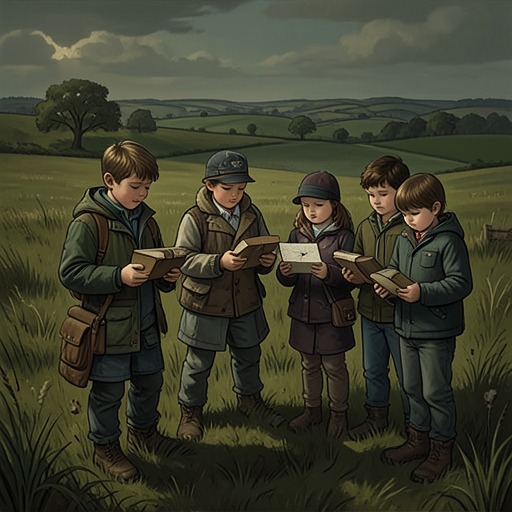
Kathy H.’s later, solitary drive through Norfolk follows Tommy’s completion. She has no particular object to find and does not go as far as the coast; instead, she wanders among flat fields beneath a grey sky. At a fence by a small cluster of trees, she sees rubbish caught along the wire and scraps of plastic tangled in the branches. The place still invites association with lost things, but what it offers is debris carried there and left behind, not a clear restoration of what has gone.
Across these episodes, the expression shifts from a children’s joke to a means of expressing care and then to a frame for thinking about memory. The cassette gives its promise a concrete, limited fulfillment; Hailsham and the lost friends remain beyond recovery. What survives is not the past itself but Kathy H.’s ability to carry its people and places in memory.